Will the Ryzen 2700x Be on Sale Again Before Christmas
AMD Ryzen 3000 Series CPUs: Rumors, All We Know About Ryzen 3
UPDATE: AMD held it'due south Computex 2019 keynote here in Taipei, revealing part of the third-gen Ryzen lineup. We're working to update this article with the new information, as there are still plenty of details that yet remain unknown. In the meantime, head over to our full analysis of the tertiary-gen Ryzen launch for the list of aircraft models. If y'all're wondering near AMD vs Intel, nosotros've got an answer.
The inflow of AMD's g-series Ryzen processors (similar the flagship Ryzen 7 1800X) revitalized the CPU market in ways we couldn't accept imagined just a few years ago, forcing Intel to become more than competitive across the full latitude of its product stack. Merely that was just the outset of AMD's assault with its new Zen-based chips. Last twelvemonth AMD moved from its original 14nm fries to the 2000-series 12nm Ryzen processors (similar the Ryzen 7 2700X) that come wielding the Zen+ microarchitecture. Now, the Ryzen 3000 series is coming. According to the latest rumors, these chips could come up with up to sixteen cores for the mainstream desktop, doubling Intel's limit of viii cores.
These newer chips were a solid evolutionary step, just at present AMD is working feverishly to bring its Zen 2 microarchitecture to market packing a 7nm manufacturing procedure. Along with an improved Infinity Fabric, the collection of new technologies will come up to market as the third-generation Ryzen 'Matisse' processors. If AMD tin pull off this feat in a timely manner while Intel still struggles to roll out its 10nm CPUs, it will mark the commencement time in its history that AMD has taken the process node lead from Intel.
AMD recently demoed the new processor during its CES keynote. While we still don't know all the details about what is coming with AMD's 3000-series processors yet, nosotros practise know they are coming to market in mid-2019. AMD recently announced that the 7nm EPYC data center variants are sampling in Q2 of 2019, and so things appear to be on rails, and we likewise know that the Zen 2-based chips volition ability Sony's adjacent-gen Playstation 5.
Final calendar week, AMD's Lisa Su besides confirmed at the visitor's Annual Shareholder Coming together that it volition launch its 7nm lineup of Ryzen 3000 and EPYC information center chips, along with the Navi graphics architecture, in the 3rd quarter of 2019. That comes on the heels of the recent discovery that Gigabyte has enabled back up for PCIe Gen iv.0 with its previous-gen motherboards through a BIOS update that you can download today. That feature will simply be fully unlocked when you pair it with a Ryzen 3000 fleck, so the stage has plainly been set for an announcement during Lisa Su'southward Computex keynote on Monday, May 24.
Permit's take a wait at what else we know, and what we don't.
Third-Gen Ryzen Performance
At CES 2019, AMD CEO Lisa Su showed off an "early" third-gen Ryzen desktop processor running a game paired with a Radeon VII. These 7nm chips volition exist the showtime desktop processors to support PCIe 4.0 x16 right out of the box. That too implies that the new 500-series chipsets will also back up the new standard.
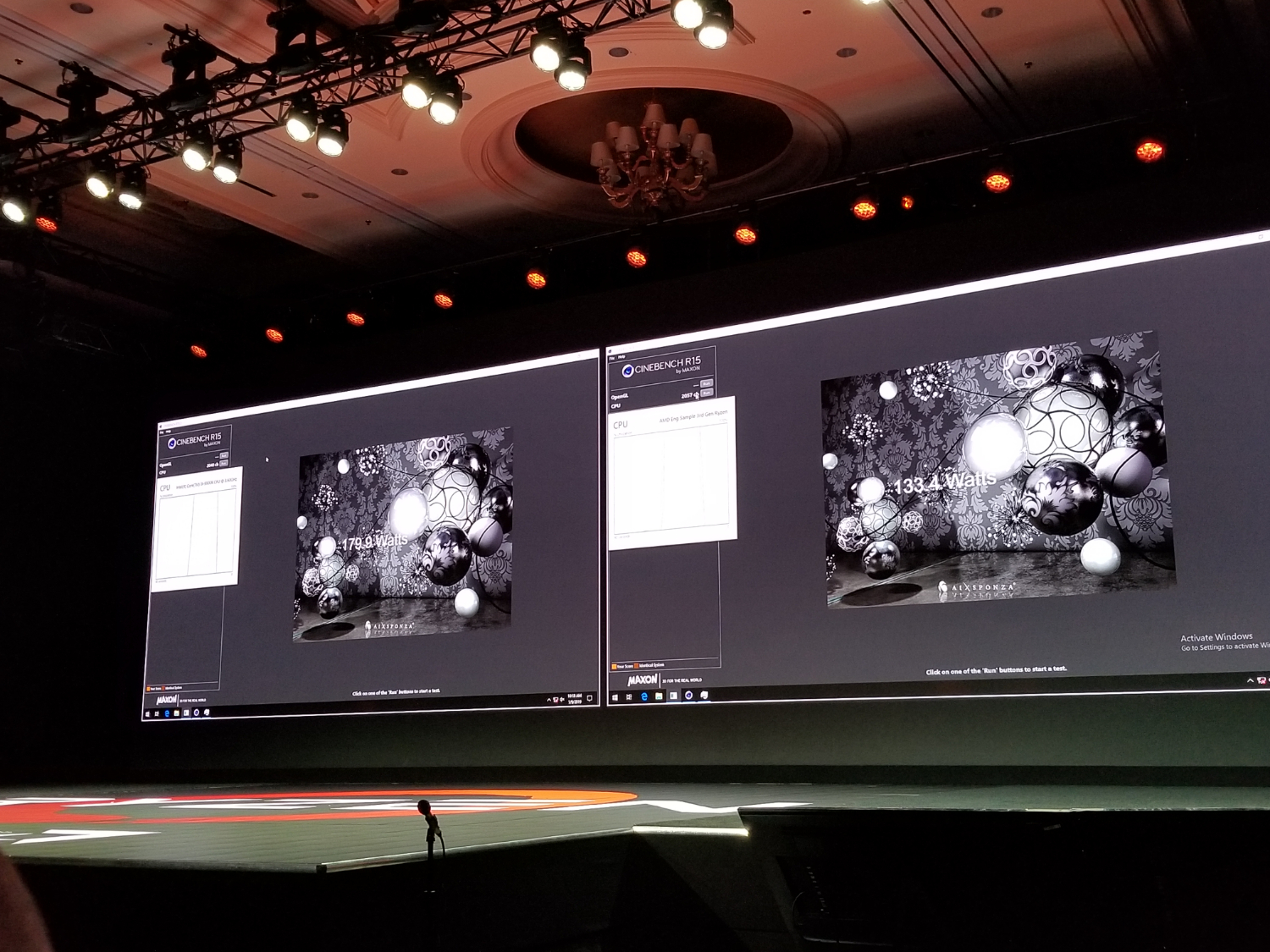
AMD demoed a pre-production Ryzen 3000-serial processor going head-to-head against a Core i9-9900K. Information technology's noteworthy that AMD hasn't fully tweaked the design notwithstanding, significant that it volition likely extract more than performance from the chip earlier it comes to market place. The eight-cadre 16-thread Ryzen processor was about even with the viii-core 16-thread Core i9-9900K in a Cinebench multi-threaded workload, with the Ryzen score 2,057 to the i9's 2040.
3rd-gen Ryzen's power consumption figures during the demo were just equally impressive – the chip consumed xxx% less power than the Intel processor during the benchmark. Intel's Core i9-9900K requires a loftier-cease motherboard, power supply, and cooler to excerpt the optimum level of performance. The Ryzen processors' comparatively low power consumption means information technology could exist much cheaper to build total systems around the chips, thus allowing AMD to offer a similar level of performance while maintaining the value advantage.
The 3rd-Gen Ryzen Bit
Every bit expected, the third-generation Ryzen processor comes with a multi-chiplet system, much like the EPYC Rome processors AMD recently announced. This modular design consists of an 8-core 7nm chiplet (fabbed at TSMC) continued to a 14nm I/O die (fabbed at GlobalFoundries). The I/O die contains the retention controllers, Infinity Fabric links, and I/O connections. Aside from support for PCIe 4.0, AMD is still keeping details about these resources shut to the chest.
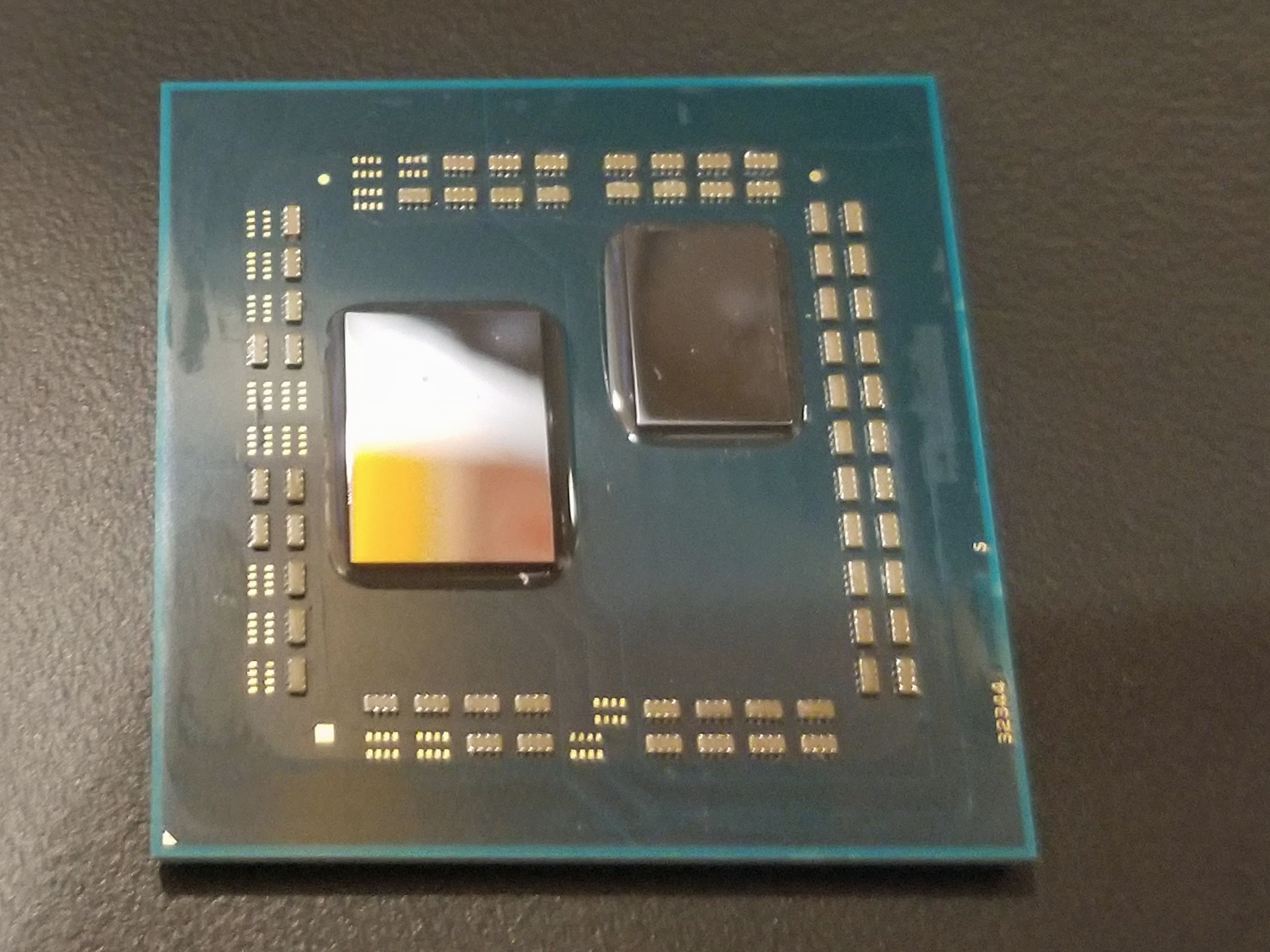
As we can see, AMD offset the larger I/O dice from the 7nm core die, leaving enough of room for a 2d viii-cadre CPU complex. Nosotros can fifty-fifty encounter what appears to be a dip in the PCB (images below) that would serve as a mounting point for another eight-core chiplet. AMD'south Lisa Su has commented that the pattern obviously leaves room for another chiplet, and that "yous might wait that we will accept more than 8 cores." However, Su did non specify how many more cores will come with the processors, or if they would arrive during the initial launch or come as a follow-upwardly series of chips. A credible rumor has emerged that AMD already has a 16-cadre variant in flight, but AMD has not officially confirmed the information.
We do know from the latest publicly-available BIOS updates that AMD has already moved forward to the B0 stepping of its silicon, indicating the Ryzen 3000 chips are nearing their final retail form.
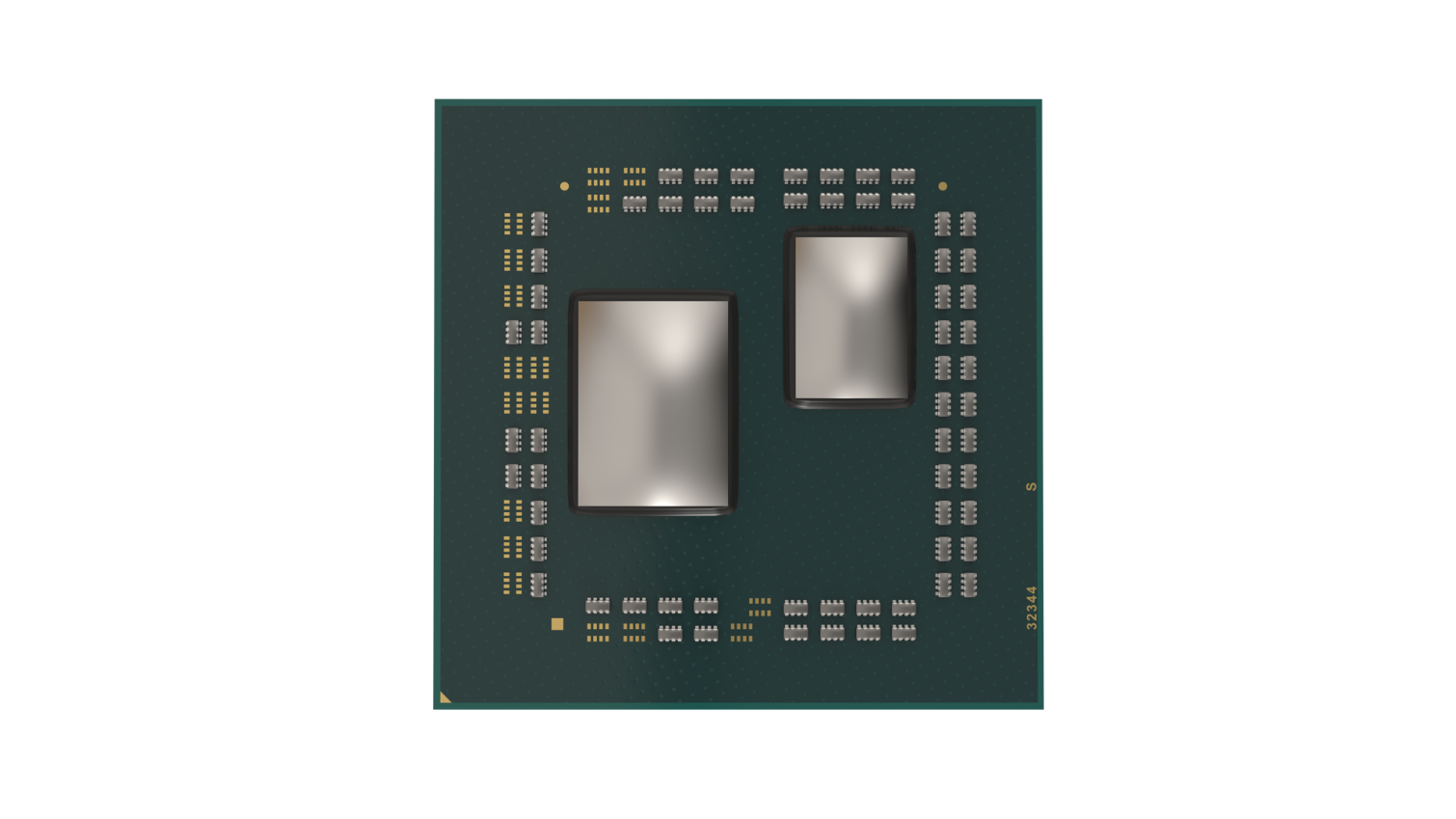
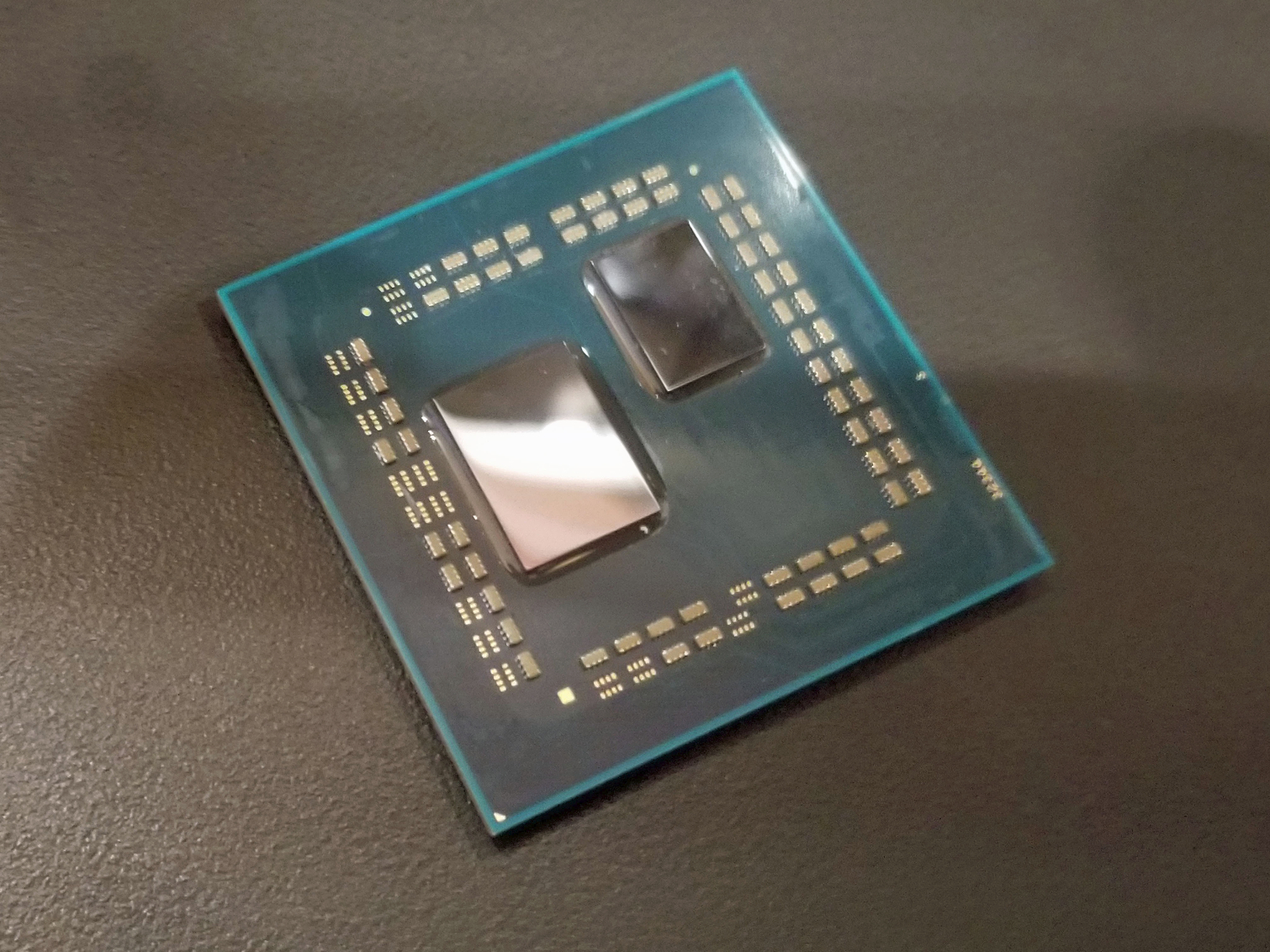
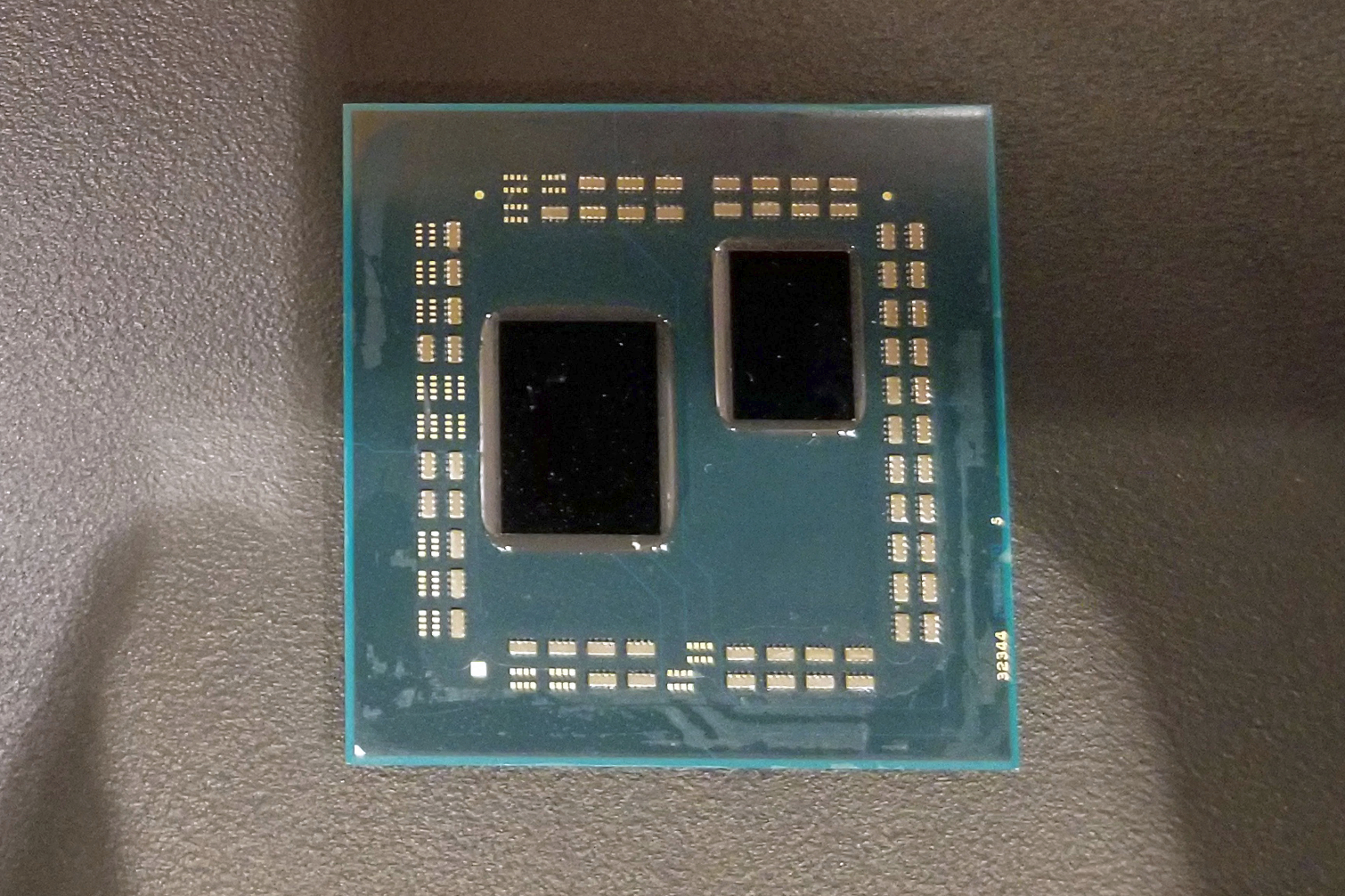
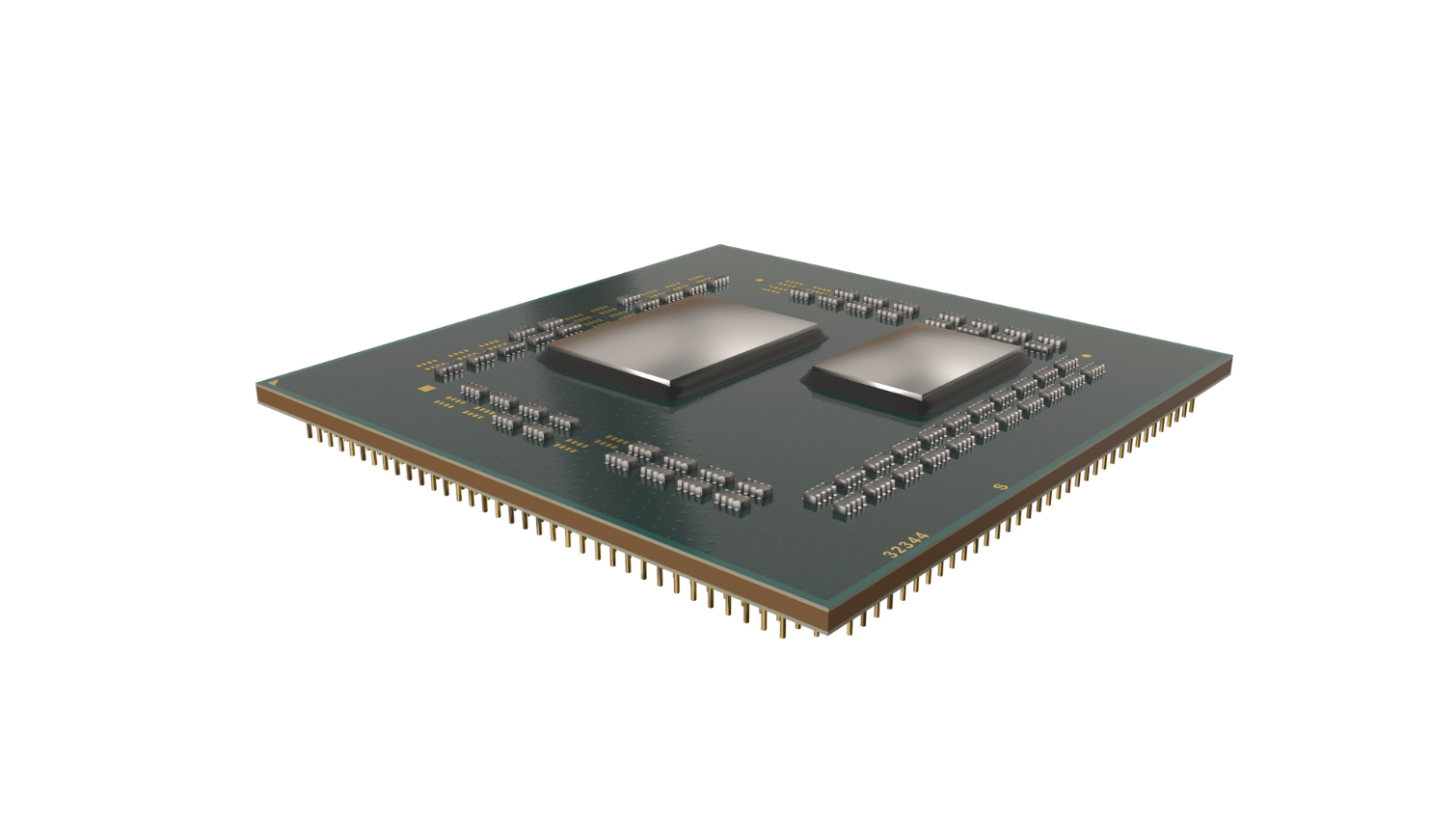
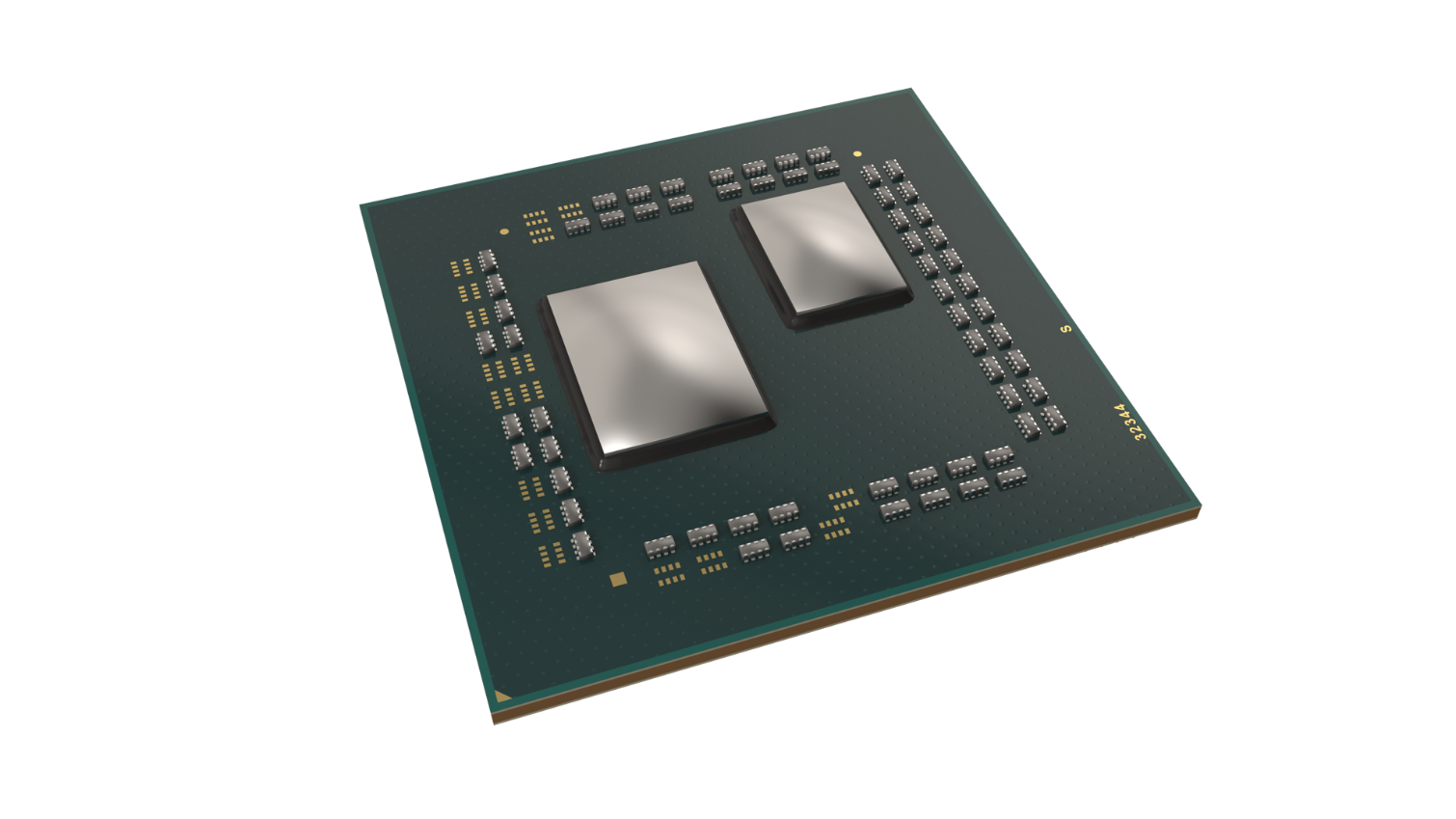
AMD is now using a 2d-gen Infinity Textile to connect the compute dice to the I/O die that serves as the linchpin of the blueprint. This blueprint helps AMD keep the areas of the fleck that don't scale well, like the memory controllers and I/O, on a proven and mature node, while also leveraging the performance, density and economic advantages of the 7nm node for the important compute functions. The innovative pattern is a sign of a broader trend in the industry to heterogeneous architectures.
It Just Works
The Ryzen 3000 serial chips come up with a radical new pattern, but luckily for u.s., the chips will work with many of the optimizations for existing Ryzen processors. AMD's beginning-gen Ryzen processors landed with a revolutionary new core design that initially led to lower-than-expected functioning in some applications. Latency-sensitive applications (like games) suffered the most, simply AMD made a concerted endeavor to arm software developers with the knowledge to tailor their code for the unique Zen microarchitecture, largely correcting the result with the mainstream desktop chips.
We asked AMD CTO Marking Papermaster if those optimizations would carry over to the new tertiary-gen Ryzen products, which he confirmed. That means the Ryzen 3000 serial chips will hit the ground running when they come to market.
PCIe 4.0 Support
AMD led the style with PCIe iv.0 back up for its 7nm EPYC Rome fries and enabled the standard on the 3000-series processors. However, AMD has confirmed to us that while the new Ryzen processors are uniform with motherboards designed for the first-gen chips, it will require new motherboards to fully support the PCIe 4.0 standard.
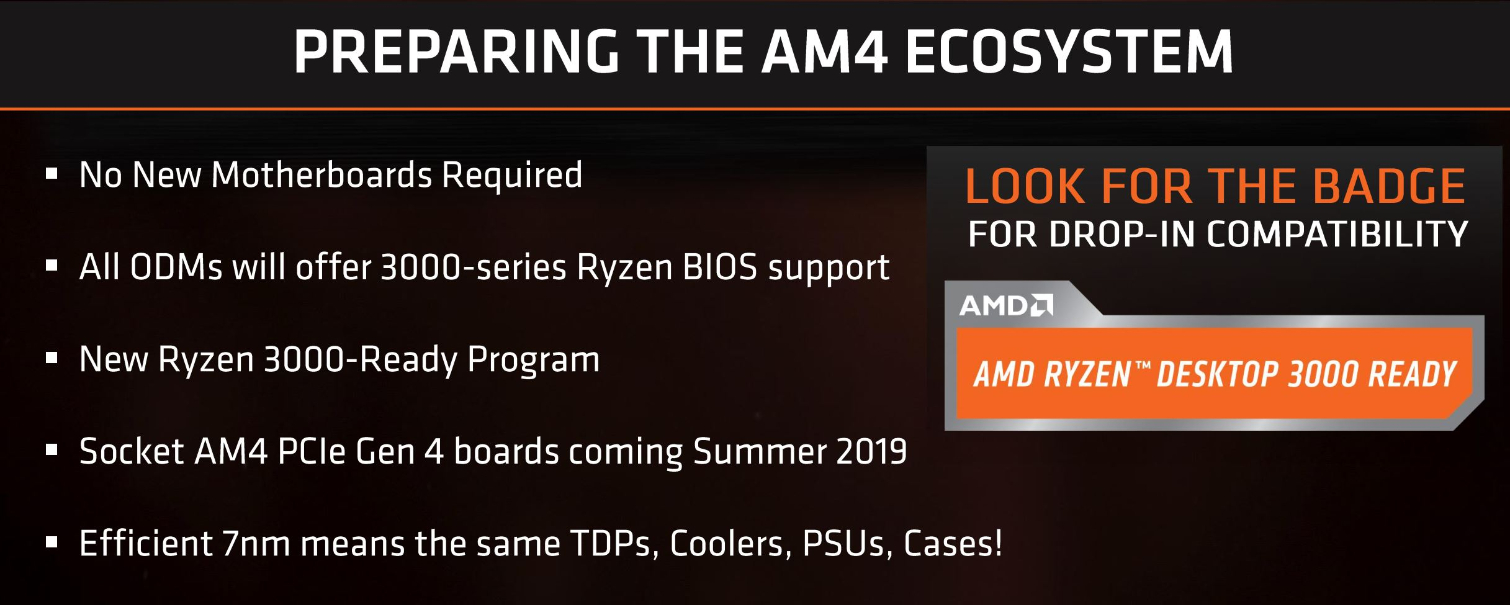
At that place is promise for existing Ryzen systems, though. AMD representatives confirmed that 300- and 400-series AM4 motherboards can support PCIe 4.0. AMD will not lock the out feature, instead information technology will be upwards to motherboard vendors to validate and qualify the faster standard on its motherboards on a case-by-example basis. Motherboard vendors that practise support the characteristic will enable it through BIOS updates, but those updates will come at the discretion of the vendor.
Most older motherboards could support a PCIe 4.0 x16 connexion to the first slot on the motherboard, but the remainder of the slots could revert to PCIe three.0 signaling rates. That'due south because any trace routing on the motherboard that exceeds six inches requires newer redrivers and retimers that back up PCIe 4.0's faster signaling rates. That means the PCIe slot nearest to the CPU volition easily support PCIe 4.0, while the other slots, including 1000.2 ports, could run at PCIe 3.0. Support could be limited to slots based upon board, switch, and mux layouts.
The 500-Series Chipset
AMD's purportedly named X570 motherboards have already begun to pop upward in online testing databases every bit motherboard vendors put their new products through the wringer, then speculation is running loftier.
The third-gen Ryzen processors support PCIe four.0, and it'southward logical to assume that the side by side-gen chipsets, largely thought to exist named the 500-Series, will likewise back up the standard. Our sources tell us the 14nm 500-Serial chipsets will consume more ability (~15W) than the 28nm chipsets (~8W) used on current AM4 motherboards, simply that'due south because the 500-serial chipsets also support PCIe four.0. We weren't told the specific lane allocations of the new chipset, merely those faster lanes volition be useful for numerous types of secondary I/O devices.
We're also told past motherboard vendors that AMD will stop using ASMedia to design its chipsets. But AMD says that it volition continue to use ASMedia, simply the new chipsets volition be "more nuanced." That could mean that AMD will design parts of the chipset and simply license cardinal IP blocks, like USB 3.1, from ASMedia.
DigiTimes muddied the issue farther with a report that ASMedia had stated that it would continue to build all AMD chipsets, simply information technology'southward notable that at that place is a difference between building and designing the component.
AM4 Socket
AMD has promised AM4 CPU socket compatibility until 2020 for all its Ryzen processors. That means yous should be able to use whatever AMD Ryzen processor on any AM4 motherboard, providing AMD'due south customers with a solid upgrade path in the future. That stands in stark dissimilarity to Intel's frequent socket changes that find enthusiasts having to migrate to new boards and chipsets. AMD's long-lived support for the AM4 socket has earned enough of cachet with enthusiasts, but it as well restricts the company's options for the new 3000-series processors.
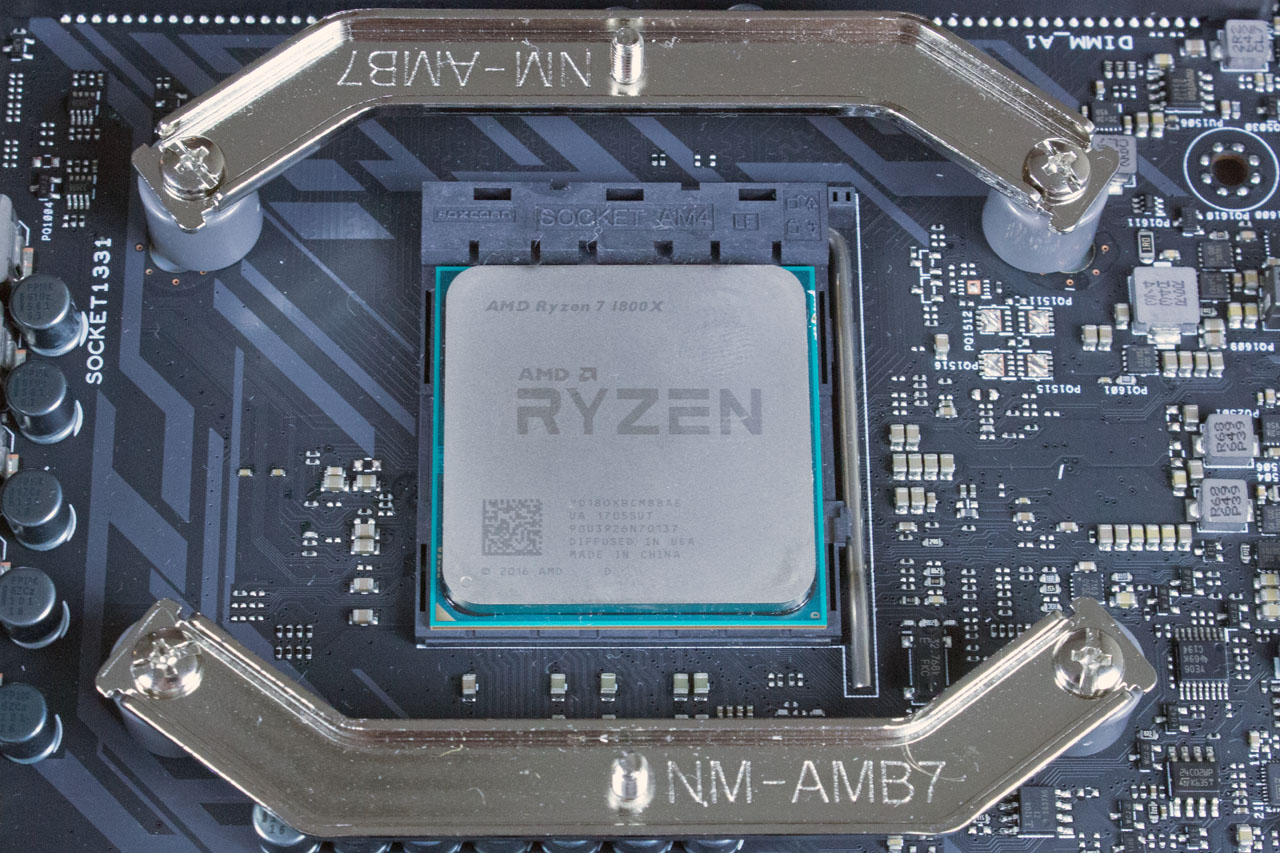
AMD and its motherboard partners have been working to deliver on that hope, with contempo BIOS updates to existing motherboards coming from all the major manufacturers. Unfortunately, for now, we have yet to see any A-Serial motherboards receive the treatment, leaving the singled-out possibility that the chips won't be supported on the existing low-end motherboards.
The AM4 socket gives u.s.a. a few hints about the possible configurations. The AM4 socket supports 2 channels of DDR4 memory, and that isn't likely to change with the 3000-serial models because each memory channel requires its own defended pins for communication. Given the current alignment of the AM4 socket, that means the new chips will likely have a dual-channel retentiveness controller.
The AdoredTV Rumor
AdoredTV famously reported that an anonymous tipster had sent a list of AMD'due south new processors. The rumor claimed AMD volition release the new Ryzen chips in Q1 2019, but several details of the rumor are questionable.
The information contended that AMD would unveil the new processors and pricing at CES, just the company didn't share such detailed information during its keynote. Nosotros expect the lack of detail virtually the Ryzen chips, every bit almost of these final touches, particularly CPU clock speeds and pricing, typically come later in the development process.
| CPU | Cores / Threads | GPU | Base / Boost Clock | TDP | Price |
| Ryzen 3 3200G | 4 / 4 | Vega viii | 3.half dozen / iv.0GHz | 65W | $99 |
| Ryzen v 3400G | iv / 8 | Vega xi | 3.7 / four.2GHz | 65W | $149 |
| Ryzen vii 3700 | 12 / 24 | - | 3.eight / 4.6GHz | 95W | $299 |
| Ryzen 7 3700X | 8 / 16 | - | 3.6 / 4.4GHz | 65W | $329 |
| Ryzen 9 3800X | viii / 16 | - | 3.9 / 4.5GHz | 105W | $399 |
| Ryzen 9 3900X | 12 / 24 | - | 4.eight / 4.6GHz | 105W | $499 |
| Ryzen ix 3950X | 16 / 32 | - | 3.5 / 4.7GHz | 105W | $749 |
Several other facets of the rumored lineup are also questionable. The pricing model outlined in the rumor would bring twice the number of cores to market place within like price ranges of the current AMD chips, which is highly unlikely given what we said in a higher place about the college cost of 7nm production. AMD did turn the industry on its ear with its revolutionary pricing model with the first-gen Ryzen processors, simply that release represented an entire reset of the visitor'south lineup.
Now the company is bringing an iterative update to market, pregnant that such radical changes to its product stack would affect its existing lineup. Bringing 3000-series processors to marketplace at these prices would cannibalize the company's existing lineup, meaning it would have to purge its unabridged supply chain to avoid having unsellable excess inventory. That isn't probable.
AMD besides recently stated during its 50th Anniversary dejeuner that its 7nm products all carry a 50%, or college, margin. That makes the promise of farthermost toll drops even more than questionable.
Others have pointed out more than obvious holes in the lineup, such every bit TDPs and frequencies that don't line upwardly evenly across the production stack. We don't think this rumor is accurate, especially given the nature of the disclosure and the pricing model. Merely just time will tell if at least some of the rumor contains accurate info. In the meantime, we've seen enough of obscure retailers post placeholders for Ryzen 3000 serial chips using the exact naming and specifications equally seen in this rumor. Information technology should become without saying, merely you should view those with extreme suspicion.
The Render of the CCX, Intro to the AMD Zen 2 Architecture
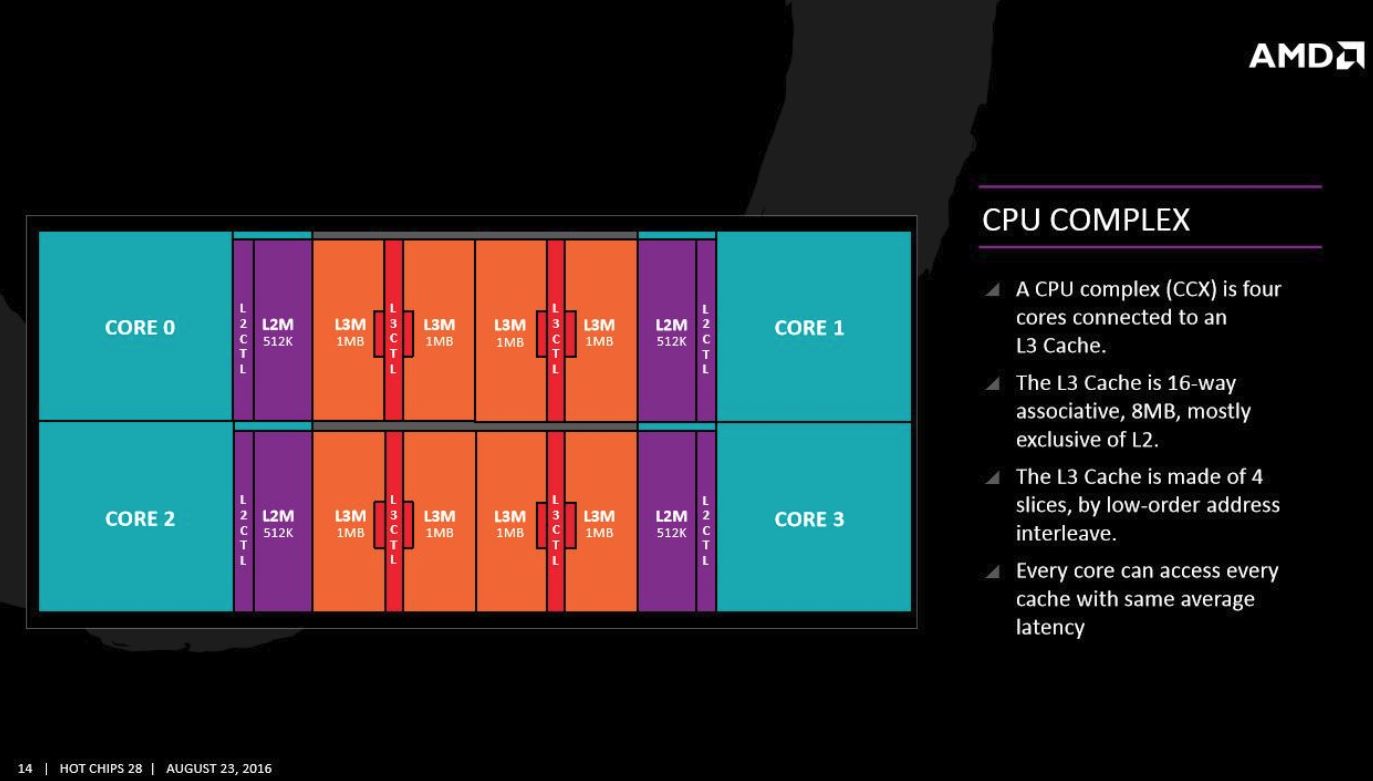
Papermaster also confirmed that the chips will come with AMD's Core Complex (CCX), which is a fundamental foundational building block that allows the company to easily scale the design of the flake. The current CCX design consists of 4 cores connected to a centralized cache split up into four slices. Each core also has its own individual L2 enshroud. Many current-gen Ryzen models come with two CCX'southward tied together via AMD's Infinity Fabric, which is a fast interconnect that serves equally a superspeed highway between the units. This allows for fast and efficient communication. The CCX'es likewise share the same memory controller.
Although nosotros know that the new fries bear this same design ethos, we aren't sure if AMD has made radical adjustments. The company may accept added more cores to each CCX, or adjusted the capacities and associativity of the caches.
The TSMC 7nm Process
AMD hasn't said much about the 7nm process that it will apply for the Ryzen 3000-series fries, though the visitor claimed during its debut of the EPYC data center chips that the procedure volition bring twice the density while halving the power consumption at the same operation level. The company claims 7nm also offers 1.25x the performance at the aforementioned power. These advantages will come to the end user in the form of faster and cheaper chips, but scaling difficulties and chip-level interconnect restrictions complicate matters as chips become smaller--meet Intel's ongoing issues with its own 10nm process.
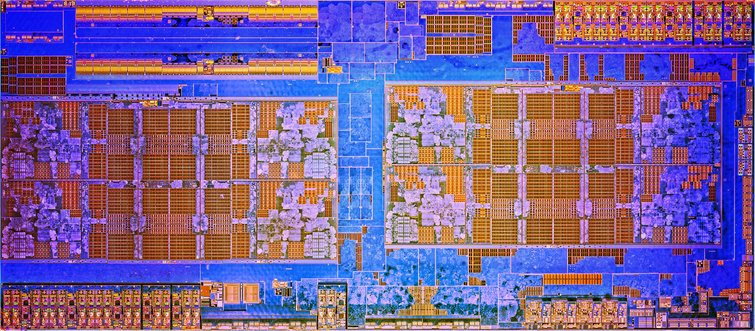
AMD's CTO Marker Papermaster tells us to expect a 25 percent increment in performance from the new process, but he reiterated to EETimes that the move to the new procedure is challenging.Papermaster also said that the move to EUV (extreme ultraviolet) manufacturing, which volition come with the 7nm+ node, volition merely provide "modest" device performance opportunities. We've also seen similar statements from AMD's Forrest Norrod, so it might be best to proceed expectations for significantly higher clocks in check.
It is important to recollect that node naming conventions have become more of a marketing practise than a metric based on hard measurements. And then TSMC'due south 7nm is not denser than Intel's awaiting, oft-delayed, 10nm node. In fact, Intel'due south 10nm process is really denser than TSMC's 7nm process – Intel'southward 10nm (6T) process is 100 mega-transistors per square millimeter (MTr/mm2), while TSMC's 7nm (7.5T) weighs in at 66 MTr/mm2.
But for at present, information technology's a race to run into who can get their new process to market place start. Intel plans to accept 10nm processors in high book manufacturing in late 2019 (presuming in that location aren't whatever more than delays), leaving AMD a big window of opportunity if it tin can make its target of mid-2019.
The loftier upward-front end costs associated with developing a new node pushed AMD's primary manufacturing partner, Global Foundries, out of the 7nm race last year. AMD remains committed to delivering the new node and using it as a vehicle to deliver the new Zen 2 microarchitecture to market, but it is partnering with TSMC for manufacturing. TSMC is the industry'due south premiere third-party foundry, so AMD volition have to compete for wafer output with large players such as Apple tree, Qualcomm and Nvidia, that too utilize the fab'south chip production facilities. However, recent reports indicate that the 7nm node is expensive, thus leading several large players to scale dorsum product development on leading nodes, thus leaving about x per centum of TSMC's 7nm production chapters underutilized. This is a double-edged sword for AMD: while the company shouldn't have any trouble sourcing wafers from TSMC, the progressively higher costs of each smaller node ways we might not see large price drops with the second-gen Ryzen chips.
For now, we wait
AMD's move to producing 7nm fries in volume before Intel can counter with its own 10nm shrink could serve a huge blow to Squad Blue, especially if AMD tin also pull it off in the middle of this year.
Only there are more gains to be had than "just" a node shrink: AMD also has its Zen ii microarchitecture coming with the 3000-series Ryzen chips, and that should bring along a squeamish improvement in instructions per clock (IPC) throughput. That could potentially push the company closer to matching Intel in one of the few areas where the blue team still has a clear advantage--performance in single-threaded applications. AMD's demo implies that it is reaching parity with Intel'due south per-cadre performance, merely we'll need a much larger spread of workloads to accurately gauge the comeback.
AMD is already extremely competitive on many fronts. But if the company can close the single-threaded performance gap (which would be beneficial for gaming performance in particular), it could set the phase for the biggest upset in the history of the processor market. And that kind of success (paired with increasing EPYC sales) would requite AMD a major influx of cash, which could assist the visitor better compete confronting its much larger CPU rival (non to mention Nvidia on the graphics front end) in 2020 and beyond.
More About AMD
- AMD Athlon 200GE Review
- AMD vs. Intel: Which Sub-$500 PC is Meliorate?
- Ryzen 2 vs Intel Java Lake
Want to annotate on this story? Let us know what you lot remember in the Tom's Hardware Forums.

Paul Alcorn is the Deputy Managing Editor for Tom's Hardware U.s.a.. He writes news and reviews on CPUs, storage and enterprise hardware.
davidpriarriank02.blogspot.com
Source: https://www.tomshardware.com/news/amd-ryzen-3000-everything-we-know,38233.html
0 Response to "Will the Ryzen 2700x Be on Sale Again Before Christmas"
Postar um comentário