What Caused Dramatic Changes to the American Family
As we head into the 21st century, changes within and among families in the U.S. are striking at the centre of our notions about life and the mode information technology functions. Such things every bit longer life spans, the appearance of condom and effective birth control, women's increasing participation in the paid labor force, and a dramatic increase in divorce rates are reshaping family life in the tardily 20th century. The new realities of family life are in sharp dissimilarity with idealized notions of the family unit that accept developed over centuries. Conflicts in the way we perceive the family are creating profound contradictions in public policy. If the family is to exist a healthy component in society, every bit it must exist for guild to survive, we need to understand anew what family is and what it is becoming.
THE Changing FAMILY
The range of variation in "families" throughout history and across cultures is enormous. Yet, in that location are sure major themes within all this variation: Families are a set of main relationships – biological, emotional, social, economic, and legal. Families are also a collection of individuals with differing needs and concerns living in complicated relationships with each other and with society. Families by and large are expected to provide their members common economic, concrete, and emotional back up, coming together the human needs for food, shelter, and intimacy. Families besides carry on tradition and culture and, in some instances, pass on holding to the next generation.
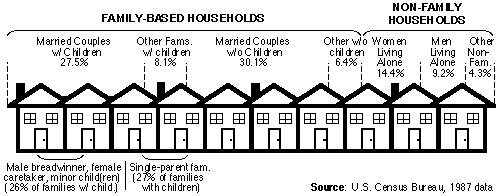
If our discussions of families began from this broad understanding, nosotros would have a useful starting indicate. Unfortunately, many discussions well-nigh families, and much of our policy and literature, assume a much more narrow definition of a "normal" family: a caretaking female parent, breadwinning father, and one or more minor children. Many of today's senior citizens formed such families and many center-aged adults grew upwards in them, but the composition and characteristics of families have changed considerably since World State of war II, especially in the final two decades. Although close to 75% of U.Due south. citizens still alive in family unit-based households (run across figure below):
- Only 9% of U.Southward. households fit that one-time definition of the "normal" family unit.
- A majority of families take no children under historic period 18.
- More than 25% of all families with children are single parent families; almost all of these have a female head of the household.
- 72% of women in the changeable years are employed. By 1995, labor force statisticians predict the proportion volition increase to 81%.
- Out of wedlock births (often past older women) are at present about xx% of all births and virtually all such children are kept by the mother rather than put up for adoption.
- For the start time, the U.S. is generationally top-heavy: there are more grandparents than grandchildren.
THE Changing WORKFORCE
A major gene affecting all these statistics has been the steady shift of women into the paid labor force. This profound shift has happened inside a single homo lifespan, too fast for many of our institutions and attitudes to keep footstep. A big number of today'south older senior denizen women have been dependent housewives for almost of their adult lives. They were raised expecting to find a husband who could support them, and for a majority of this generation the breadwinning married man/caretaking wife model worked.
Their daughters were often employed before their marriage and until they had children. After the children were in school, many reentered the workforce, demonstrating that their involvement in the workforce was not a temporary aberration. In 1965, 41.ane% of women aged 35-44 were in the paid labor force. Twenty-1 years later this same cohort of women (now 55-64 years sometime) were represented in most the same proportion, 42.3%. (An interesting question is to what extent these were the same women being employed or whether individual women moved in and out of the labor force depending on family unit circumstances.)
The younger sisters of this age cohort followed their elders' example and added momentum to the trend. In 1965, 38.v% of women anile 25-34 were in the paid labor strength. Past 1986 this same group – then aged 45-55 – had a 66.3% rate. These women were manifestly more defended to paid employment than is commonly believed, merely gild nonetheless maintained the fiction that women were caretakers and men were breadwinners.
What'southward interesting – but not ofttimes perceived or discussed – is that as women's employment has increased, men's employment has decreased. During the concluding 25 years women's employment has increased by 30% or more in every age category up to age 55 while men's employment has declined in every age group over historic period 25. This tendency represents a profound shift in lifestyles and contradicts long-held cultural assumptions.
FORCES BEHIND THE CHANGE
There are strong economic forces at work backside this shift. For a smashing bulk of younger families, it is no longer practical to remember in terms of a "family wage" – plenty income from 1 wage earner to support a family unit, the children'south teaching and the couple's retirement. Virtually every younger family (and many older ones) now assumes that the wife and female parent tin – and must – be an economic contributor to the family.
Family income has dropped over the concluding decade and a half, unless there is a second earner. In February, 1988, the Congressional Budget Office released a report: "Trends in Family unit Income: 1970-1986." Staff of the U.Southward. Firm of Representatives' Select Committee on Children, Youth and Families analyzed these findings and ended that although "family income for the typical family rose during this menstruation … income gains were not evenly distributed. Low income families with children, young families at all income levels and poor unmarried mother families in 1986 were much worse off than their counterparts in 1970." The main reason family incomes rose was "the increased number of workers per family, non increased earnings by the typical worker. Many families with children have needed to have both parents work to avoid losing basis."
By contrast, amidst "elderly unrelated individuals and elderly families without children, median family income rose l%." Noting that "earnings failed to keep pace with inflation for many workers, especially those in the younger historic period groups," the analysts found that "adding a 2d earner to the workforce or increasing the second earner's work hours was often necessary to keep family income from falling…. These altered work arrangements take resulted in parents (specially mothers) having less time with children, less leisure time, and possibly, fewer children." (italics added).
Even if the family wage concept were an actuality, the incidence of divorce (and the record of support and maintenance awards and payments after divorce) indicate to women of all ages that at that place are no public or individual guarantees of economic support in exchange for carrying out the caretaker role. Paid employment exterior the dwelling house is at present the accepted class of self-insurance for women also as men. Fringe benefits such as wellness insurance and social security are an almost mandatory chemical element of cocky-sufficiency when increasing life spans are taken into account.
Yet while women have moved into the paid workforce in such numbers that employment is no longer gender-based, the care and maintenance of household and children mostly has remained the province of women. The physical and emotional work of maintaining families, especially those with immature children (who crave years of almost constant supervision and nurture), is very demanding, but it is just but beginning to be appreciated by policy makers and club at large.
The changing human relationship to work is likewise changing the pattern of rights and expectations within spousal relationship. Despite strong cultural traditions and the need of about humans for intimate relationships, information technology is increasingly articulate that individuals who are required to exist economically cocky-sufficient have less tolerance for unequal familial relationships than those who are economically dependent. As women's attachment to the paid labor force grows stronger, they are asserting their rights to power and control in family conclusion-making more than vigorously. When those rights are not respected, many women either practice not enter into, or depart from, what they consider intolerable family relationships. Men practice the same.
The questions raised past these shifts are profound and disturbing. Can we withal rely on families, as we have in the past, to produce healthy and effective workers and citizens when it ofttimes takes two earners to support a young family? Where volition the time and effort for family life come from? Even more than and so for the 27% of U.Southward. families with children and only one adult, nigh ofttimes a female parent: where does the time, energy and coin come from to enhance those children? Co-ordinate to 1987 Census reports, twenty% of U.S. children lived in poverty in 1986 (up from 1978), with children under historic period six nigh at risk. A majority – 51.4% – of families below the poverty line were female person-headed, illustrating the difficulties posed when women solitary endeavor to maintain families, assuming both the caretaking and breadwinning roles.
In response to these shifts, volition increasing numbers of young women decline marriage or maternity, the creation of new families, because of their desire and power to gain meliorate security and status through paid employment? Will those who have piffling hope or expectation of paid employment be the major procreators? Or will standards and norms about work and family modify? Volition men share the caretaking and household maintenance functions every bit women share the breadwinning function? Will women surrender control inside the household? Who will care for and nurture the young as both men and women piece of work for pay? Will society, to preserve and regenerate itself, devise ways to assist care for the vulnerable immature equally they accept for the vulnerable onetime?
THE Claiming AHEAD
As the 21st century approaches, the time and energy required for kid begetting and rearing, the importance of intimate relationships, and the need for family unit policies that take into business relationship the diversity and irresolute nature of American families will need to be increasingly understood and appreciated if our gild is to survive. Caretaking for the adjacent generation tin no longer exist assumed to be a "gratis proficient" with the costs borne most solely by individual parents or families.
Child bearing is now an choice. That selection must be made more attractive and less expensive to the private and to families, or additional numbers of women and families will limit their child bearing. We must also face the reality that human young are vulnerable for years, and that constructive child rearing is mandatory for a humane society. Lip service does not buy groceries or assure a kid'southward development into a competent and satisfied developed. A new social compact between men and women, betwixt rich and poor, between generations, and between society and the family volition need to be devised. The elements of that meaty are even so unclear; what is clear is that women are in the paid labor force to stay, at least for a major portion of their developed lives.
Some steps have already been taken or are beingness discussed; for example, motherhood and paternity exit, child care subsidies or revenue enhancement credits, actress tax deductions for families with children, and the quality of educational activity have been put on the public agenda. There are signs of a new generation of "working fathers" – men deeply involved with their children, caring for them as mothers have always done – and even "househusbands." Such men are notwithstanding rare plenty, however, to exist remarkable; and unfortunately they are frequently ostracized.
What is also remarkable is the resistance amidst many women to giving up command of the caretaking function in families. Fifty-fifty though women's work in the domicile has been demeaned, the home was withal the "province of women" where they had a mensurate of power, some social value, and often a sense of satisfaction. An important question for the time to come is whether women will be willing to requite upwardly command in the domicile in order to proceeds greater power in the workplace and the public arena.
In the side by side century the child-bearing and kid-rearing years may well be considered as valued a time of life as the retirement years. It is possible that workers who are the parents of young children may be encouraged to take a kind of sabbatical, dividing their time betwixt family care, part-time employment, and farther education or training. Parents of immature children may be allowed and encouraged to collect some of their social security during the regenerative years.
The work week may be shortened and employment patterns over a lifetime may go on to modify for both males and females to accommodate changes in family circumstances. Health intendance support for the young and their parents may become every bit accepted as Medicare and public education. Every bit people live longer, patterns of living, working, and thinking virtually one's lifetime will continue to change. More men may detect diversity in piece of work and family life equally satisfying and challenging as have some of the electric current generation of mothers and grandmothers. Equality between men and women, once tasted and experimented with, may be appreciated and fifty-fifty savored.
We may understand and acknowledge the fact that raising a child and participating in family life breeds wisdom and satisfaction. Caretaking also teaches skills like management, prioritizing, and negotiation that are transferable and might be rewarded in the futurity, or at to the lowest degree valued. As family unit life and children – the hereafter incarnate – go more fully appreciated, new concepts of success may sally that equate the successful raising of children with career achievement.
People of all shades of the political and racial spectrum live in families. Permit us hope that we tin can employ this common ground on behalf of families and children as a basis for new social innovations in the 21st century comparable to the technological advances of the 20th century.
Arvonne Fraser is a Senior Fellow at the Humphrey Plant of Public Affairs, University of Minnesota.
davidpriarriank02.blogspot.com
Source: https://www.context.org/iclib/ic21/fraser/
0 Response to "What Caused Dramatic Changes to the American Family"
Postar um comentário