Is Did You Know Phrase Effective Communication
No matter where we are or what language we speak, sometimes we have trouble communicating.
Advice bug don't e'er happen because of your English level.
The truth is, yous can know how to speak English without knowing how to communicate in English.
What's the divergence?
Read on to find out—and learn how to fix the nigh basic advice errors!
Contents
- How Do People Communicate Clearly in English?
- The 3 Important Rules of Communication
- 8 Essential Tips for Clear Communication in English
-
- one. Keep talking
- 2. Find a skillful speaking rhythm
- 3. Make certain y'all're understood
- 4. Repeat what you lot're told
- v. Inquire clarifying questions
- 6. Watch your body language
- 7. Utilize appropriate linguistic communication
- viii. Practice empathy
Download: This blog postal service is available as a user-friendly and portable PDF that yous can accept anywhere. Click here to get a copy. (Download)
How Exercise People Communicate Clearly in English?
Even native English speakers take problem communicating sometimes. Problems in advice happen when the connexion is lost betwixt a speaker and a listener. Somewhere forth the style, the information that's being transferred is lost or mixed up.
Hither are some ways that communication problems can happen:
- The speaker doesn't express him/herself clearly enough.
- The speaker uses language that the listener doesn't empathise.
- The listener does not understand the speaker.
- The listener is not paying enough attention to the speaker.
There are ways to prevent communication errors, as both a speaker and a listener. All you take to do is remember three very important rules of communicating, and follow a few basic tips to really better your communication skills in English.
The 3 Of import Rules of Communication
In any language, at that place are three extremely important points to remember when you lot're communicating with someone.
1. Say what you hateful. It tin exist difficult to express (say) some ideas clearly, merely if you're trying to prevent miscommunication, it'south important to say exactly what you hateful. Be articulate and to the point.
2. Inquire questions. Communication is two-way, which means you can't be the one doing all the talking. To make sure your listener is engaged (interested in what you have to say) and understanding yous, ask questions. See #5 below for good types of questions to ask.
3. Listen. We mean actually mind. Hear what your speaking partner has to say, and try to understand what they mean.
Following all three of these rules will brand you excellent at communicating in English (and probably in your native linguistic communication equally well).
Of course, as an English learner y'all might accept a difficult fourth dimension communicating in English language because of the language barrier. Don't worry—here are are some tips you can use if y'all desire to sympathise (and be understood) better.
8 Essential Tips for Clear Communication in English language
one. Keep talking
The trouble:You lot may accept trouble speaking fluently if y'all're unsure of your grammar or vocabulary. However, stopping a lot when you talk can make information technology difficult for people to focus on what you lot're saying.
The solution:Know your filler phrases!
Filler phrases are phrases (and words) that human activity like placeholders in a judgement. They fill up in silences so that your speech is not interrupted. They don't actually add anything to the conversation, though, and so they requite you a little time to think of what to say.
Some examples of filler phrases are:
- Um, uh
- You know…
- To be honest…
- Really…
Y'all can find a longer list of filler words and phrases here.
As with whatsoever practiced thing, don't overuse them! Also many filler phrases are just every bit bad as likewise many pauses. To observe a good rest, attempt non to use more than one filler phrase for every couple of sentences y'all speak. Yous volition find that this gets easier as you work on it.
Effort it yourself:Observe a topic you tin can comfortably talk near for a few minutes (you can apply one of the conversation starters here). Tape yourself speaking nearly the topic in English for a few minutes. When you're done, listen to your recording.
How often exercise you end? How often do yous use filler phrases? Try recording yourself once again speaking nearly the aforementioned topic, merely this time watch out for using too many pauses or filler phrases.
2. Find a skilful speaking rhythm
The problem:If you effort to speak likewise fast, your words don't come out right. But if y'all try to tiresome downwardly, you have trouble focusing.
The solution:You lot need to work on your speaking rhythm, or the speed and "audio" of your speaking.
Finding your perfect speaking rhythm will really aid to improve your fluency. A good speaking pace is comfortable for you lot and the listener, keeps yous focused, and gives you lot plenty time to think through what you desire to say.
Effort it yourself:To find the perfect rhythm, y'all might have to experiment a footling. Detect a short paragraph, or even just a judgement to say. (Y'all tin endeavor using some of these silly one liner jokes. Bonus points for understanding the humor!)
Say the sentence slowly, then once more faster, and over again. Once you reach a speech that doesn't feel comfortable (is as well fast), slow back down. Repeat this with a few sentences, and soon you lot'll find that perfect speed.
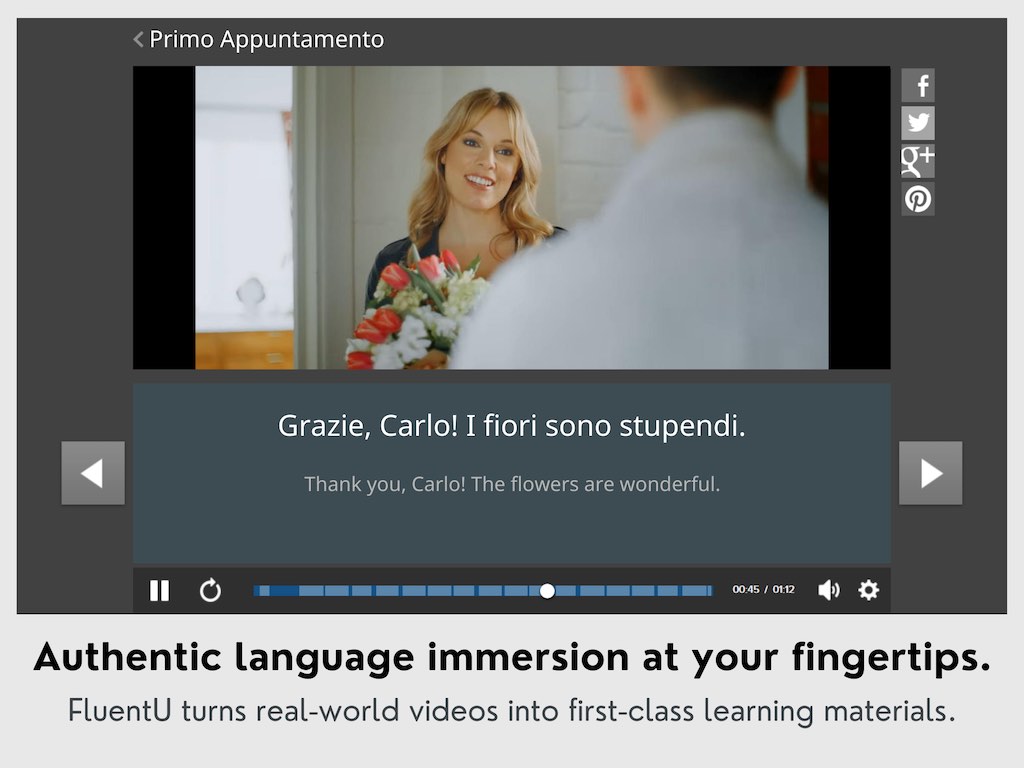
Once you find the right speed, you lot tin can work on the rhythm, which is the stress and intonation (how loftier or low a sound is) of your voice when you speak. To do this, cull a video that has subtitles. For the sake of illustration, we'll talk about watching videos on FluentU, but you can adjust these tips to other platforms.
From this video, choose one judgement. Play information technology once, then play it over again and say information technology along with the video. Repeat! (If you're watching on FluentU, just click the "replay" push button to repeat a line of the video over and over.) Attempt to lucifer the speed, stresses and overall sound of the sentence as you speak.
If y'all demand extra assistance with a specific word and you're on FluentU, you can employ the built-in multimedia lexicon—just hover over the word in the interactive subtitles for on-screen information.
Play the pronunciation clip over and over again until yous tin can clearly discern all the sounds in the word. Then, endeavor to go your own pronunciation as close as possible to what you but heard.
3. Make sure you lot're understood
The problem:Because of the language barrier, you're never certain if people really understood what you meant.
The solution:But ask them. Most of the time, you tin make certain someone understood what you said by asking them to repeat what yous said.
If you're worried about sounding rude, you tin remind them that you are nonetheless learning English, and you want to make certain you expressed yourself correctly.
Endeavour it yourself:Practice with a speaking partner, or simply try this in whatsoever English chat: The next time yous give any instructions, directions or data, follow it upwardly with one of these phrases:
- I want to make sure you got that. Would you listen repeating it?
- I'm not sure if I said that correct. Can you please repeat it?
- Can you please run that by me, and so I know you got it?
- I'd like to be sure I'm expressing myself conspicuously. Could you delight tell me what I've merely said, so I know we're on the same folio?
By having the listener echo what you said, y'all can make certain yous were understood, or clarify annihilation they didn't get (empathize).
4. Echo what you're told
The problem:Sometimes you're not certain if you understand what others mean, and yous don't know how to check.
The solution:Don't be agape to ask people to echo themselves. Most people will agree that it's meliorate to repeat themselves than to take misunderstandings. An even more effective mode of making certain you understood right is to repeat what you heard.
Whenever you're getting information and you lot're non certain y'all understand it, just say it back to the speaker in your own words. This volition give them a take a chance to correct any you did not understand, or confirm that yous heard right.
Effort it yourself:You can practice this with a speaking partner too, or in an actual English conversation: Echo new information back to the speaker.
You tin can utilise these phrases earlier the information:
- I want to make certain I got that right, …
- So let me get this straight, …
- You mean…
- If I'1000 understanding you correctly, …
You tin too try this with anything yous read or watch. After you read or picket something, have a moment to explicate in English what you just learned. This will help yous piece of work on your summary and agreement skills.
5. Inquire clarifying questions
The trouble:You just don't understand what you're being told.
The solution:Sometimes y'all don't understand enough information to be able to repeat it. Other times y'all experience like you simply understand something partially. In these cases, you can ask questions that will analyze (or clear up) any misunderstandings or whatever information you're missing.
Try it yourself:The types of questions you ask volition vary based on the chat you are having. Yous can notwithstanding practice asking good questions with a partner by playing games like "20 Questions."
To play, your partner thinks of a person, identify or affair. Yous have to figure out what they're thinking of by asking yeah or no questions, like "Is it a living affair?" or "Does information technology like taking naps in sunny spots?" (If the reply to both is "aye," maybe information technology'south a cat!)
Y'all can practice asking clarifying questions when y'all don't understand something in an English grade. Yous can also practice this when you read anything on the Net. Every bit you read, ask yourself questions about anything that yous don't understand or any data that is missing. If you read this article, for case, you might be wondering "How much is the disbelieve?" or "How much does Starbucks throw out instead of recycle?" Asking these questions will help your advice skills, reading comprehension skills and general agreement of the world around you lot.
6. Spotter your body linguistic communication
The problem:Yous are saying one thing, only your body is saying something different.
The solution:You might not know this, but your trunk speaks most equally loudly as you. The mode you sit, the way you lot concord your hands, even which direction you look at—all these things can change the meaning of the words you speak.
For instance, if you tell someone you would love to have luncheon with them, but your arms are crossed and yous're not smiling, they might retrieve that y'all don't actually want to do it. If you're nervous virtually speaking English incorrectly, you lot might show negative trunk language. And you might exist misunderstood because of that. And so the most important thing is to relax!
For native speakers, most body language is intuitive. That means y'all exercise it without thinking most or having to learn it. Not all of information technology, however, is universal. That is, not all torso linguistic communication and gestures hateful the same thing in unlike cultures. (Then y'all might have to practice some learning hither!)
In that location are some things to continue in mind when you're speaking English:
- Avoid some paw gestures. Showing but the middle finger with the rest of the fingers folded down is considered an offensive gesture. In the UK, making a 5 sign with your index and heart finger is as well considered rude (in America, it's merely a sign that means "peace," which isn't rude at all).
- Do use your hands to speak, though. You can use your hands to testify that you're excited or interested. Slamming a fist into an open hand shows determination. Slamming an open palm or a fist into a table can show anger. Keeping your easily closed and folded on your breast, however, makes you seem cold and uninterested.
- Fingers tin speak too. You can count on your fingers. Start with your fingers closed into a fist and count from the index finger if you lot're in America, and get-go from your thumb if you're in most other English language speaking countries. Y'all can likewise make an "okay" sign past keeping your last 3 fingers open up, and making an "O" with your alphabetize finger and thumb. There many other finger gestures you tin can learn—watch some native speakers!
- Crossed legs can mean different things. If you cross your legs towards the person you're speaking to, this shows you're listening to them. If yous cross your legs abroad, information technology can prove you're not interested or are distracted. This kind of body linguistic communication is non something people learn, just they might notice that something feels wrong, or that you lot seem disinterested.
Aside from these tips, body language varies depending on where you lot are. Picket others to understand how their bodies speak along with their words. The next motion-picture show or TV show you lot watch, pay attention to body language. Discover the situation and mood of the speaker when they make certain gestures.
Try it yourself:Sit in front of a mirror and speak for a scrap. Pretend yous're having a chat with your reflection. (You can use the conversation starters from tip number one.) What are your hands doing? What almost your legs? What does your posture say? Move around and try different things, and run into how they change the pregnant of the words yous're speaking.
Notice a comfortable way of speaking and endeavour to relax. When you lot're speaking to an actual person in English, you can recall this exercise and call up what your torso feels like when you're relaxed.
It's a good idea to repeat this practise while standing as well. It can be more difficult to know what to do with your hands when yous're standing, for instance.
seven. Utilize appropriate language
The trouble:You know "regular" English, so you lot're not certain how to communicate to someone who speaks professional English or uses slang.
The solution:Sometimes it'southward advisable to switch to a more casual or a more formal manner of speaking. Depending on your English learning goal, you might already be learning professional or conversational English. Heed to how your conversation partner is speaking, take find of your state of affairs and surroundings, and try to friction match the type of English.
If you're only learning regular English, don't worry: Nigh of the time standard English works perfectly well as a communication tool, no matter who you're speaking to.
Try it yourself:If you're interested in professional or conversational English, a good place to start is by reading a scrap about them online.
FluentU has lots of weblog posts on both topics that you can read, similar this commodity on how to learn professional person English, or this mail service with very casual phrases. Scan all of the posts here for more vocabulary and tips on how to keep your learning. Use the search bar by entering terms like "work," "professional person," "formal," "slang," "casual" or "conversational."
8. Practise empathy
The problem:You sympathise the words someone is proverb, but you don't understand why they said it, or maybe you even disagree with it.
The solution: Imagine that y'all detest the cold. You mention this in conversation to someone, and they exclaim that they love cold conditions. You lot know that you heard the words right, merely it merely doesn't make sense to you. What you lot need here is empathy.
Empathy is the ability to understand what someone else feels, and it's an important part of communication in any language. Showing empathy is of import for listening well. You can't merely listen to a person's words, you need to understand what they're proverb, and try to understand what they mean.
Yous might not always concord with someone, or they might not ever tell you lot exactly what they mean, but you lot tin can endeavor to empathize their indicate of view. To practice empathy, ask yourself what your speaking partner feels and thinks, look at their trunk language, and try to sympathise what their words mean to them.
Try information technology yourself:Role play can help you learn how someone else might feel. You can practise this alone or with a partner (or a group). To do the exercise, create a listing of characters and a list of questions like this one. You can employ a character creation tool similar this i, or brand ane upward on your ain. Requite the characters personality traits that y'all don't take. (For example, if you're shy, make a character confident and outgoing.)
At present choose a graphic symbol and answer a few questions from your list, from their point of view. Pretend you are the character and answer as you think the character would answer. This exercise volition help yous see the globe through other people's eyes.
Communication is important in whatsoever language. Follow these tips to meliorate your communication skills in English language, and in any other linguistic communication!
Download: This blog post is available as a convenient and portable PDF that you tin take anywhere. Click here to go a re-create. (Download)
davidpriarriank02.blogspot.com
Source: https://www.fluentu.com/blog/english/english-communication-tips/
0 Response to "Is Did You Know Phrase Effective Communication"
Postar um comentário